

Rising above the skyline of Kampala, the National Social Security Fund (NSSF) Pension Towers Phase II is one of Uganda’s most prominent commercial developments and a significant addition to the capital’s evolving urban landscape.

Located in the Nakasero area of Kampala, the development is designed as a modern commercial complex combining a high-rise central tower with two connected side wings. The project is intended to provide high-quality office, retail, conference and supporting commercial facilities within one integrated development.

With its distinctive vertical profile and large-scale architectural form, Pension Towers is positioned to become one of Kampala’s most recognizable commercial landmarks.

A Major Commercial Development in the Heart of Kampala

According to NSSF Uganda, Pension Towers comprises three interconnected towers reaching up to 32 floors, with a total built-up area of approximately 75,000 square metres. The complex has frontage on both Lumumba Avenue and Nakasero Road, placing it in one of Kampala’s key commercial districts.

CHINASTAR’s project documentation describes the development as a central main tower connected to two lower wings, with approximately 71,000 square metres of construction area. The design includes four underground parking levels, commercial and conference facilities on the lower floors, office accommodation in the main tower and side wings, and a rooftop helipad.

The central tower is based on a reinforced-concrete structural system, while the side wings incorporate both concrete and steel structural elements to achieve the building’s distinctive architectural form.

Supporting Kampala’s Continued Urban Development

The project reflects the continuing transformation of Kampala as demand grows for modern office environments, commercial facilities and higher-quality urban infrastructure.

As Uganda’s economy expands and Kampala strengthens its role as a regional business center, developments such as Pension Towers contribute to the creation of new commercial space capable of supporting both domestic and international organizations.

Beyond its scale, the project represents the growing complexity of construction in East Africa, where large developments increasingly require coordination between engineering, structural systems, manufacturing, façade work, construction management and specialist technical disciplines.

Engineering a Distinctive Landmark

One of the most recognizable aspects of Pension Towers is its architectural composition.

Rather than using a conventional rectangular tower profile, the development combines a strong vertical central structure with lower connected wings. This creates a more dynamic silhouette while allowing the complex to accommodate a broad range of commercial functions.

The project therefore presents several engineering challenges, including the integration of high-rise reinforced-concrete construction with structural-steel elements, façade systems and complex connections between the main tower and lower building volumes.

Projects of this scale require careful coordination between design, production, logistics and on-site installation to ensure that structural, architectural and construction requirements are successfully integrated.

Strengthening Experience in East Africa

CHINASTAR includes the Uganda NSSF Tower among its portfolio of major engineering projects in Africa. The company has developed a long-term presence in East Africa, with operations and project experience across Uganda, Rwanda and other regional markets.

Its continued participation in major regional developments reflects the broader growth of its engineering and construction capabilities across areas including steel structures, prefabricated construction, façade systems and integrated project delivery.

For Africa Star, projects such as the NSSF Pension Towers also demonstrate the importance of combining international technical expertise with local execution capability.

Building for Long-Term Regional Growth

Large commercial developments are playing an increasingly important role in the modernization of East African cities.

As Kampala continues to expand, investment in modern commercial infrastructure can help create higher-quality business environments, support private-sector growth and strengthen the city’s attractiveness to regional and international enterprises.

The NSSF Pension Towers development reflects this broader transformation — combining scale, engineering complexity and architectural ambition within one of Uganda’s most important urban centers.

Africa Star remains committed to supporting the development of high-quality engineering and construction solutions across East Africa, contributing experience, technical capability and long-term value to the region’s continued growth.

In April 2025, Gong Wu accompanied a delegation led by Gao Yunlong, Vice Chairman of the National Committee of the Chinese People’s Political Consultative Conference and Chairman of the All-China Federation of Industry and Commerce, during a visit to the United Nations Office at Nairobi (UNON) in Kenya.

The visit formed part of an official delegation tour of South Africa, Kenya and Ethiopia from April 16 to 26, aimed at strengthening economic and business engagement between China and Africa and creating additional platforms for cooperation between Chinese private enterprises and African partners.

During the visit to Nairobi, the delegation met with Zainab Hawa Bangura, Under-Secretary-General of the United Nations and Director-General of the United Nations Office at Nairobi, and exchanged views with representatives of international organizations and regional stakeholders.

Strengthening China–Africa Business Engagement

The delegation’s visit reflected the growing importance of private-sector cooperation in the broader China–Africa relationship.

According to the All-China Federation of Industry and Commerce, the delegation engaged with government institutions, business organizations and international bodies across the three countries, discussing opportunities to deepen cooperation in areas including manufacturing, agriculture, information technology, cultural tourism, digital economy and green development.

For companies with long-term operations in Africa, such exchanges provide an important opportunity to better understand regional development priorities, strengthen communication with local institutions and explore new models of sustainable cooperation.

Gong Wu’s participation in the visit also reflected CHINASTAR’s continued engagement with East Africa and its long-standing focus on building relationships across the region.

A Strategic Visit to the United Nations Office at Nairobi

The United Nations Office at Nairobi is one of the United Nations’ principal offices outside New York and serves as a major center for international cooperation in Africa. The Nairobi complex is also the UN’s principal headquarters presence on the African continent and in the Global South.

The delegation’s visit provided an opportunity to gain further insight into international development priorities and the role of enterprises in supporting sustainable economic and social development across Africa.

Against a background of accelerating urbanization, infrastructure investment and industrial development across East Africa, collaboration between governments, international organizations and private enterprises is becoming increasingly important.

For engineering and construction companies, this means moving beyond traditional project delivery and contributing to broader goals such as:

  • local industrial development
  • employment and skills development
  • sustainable infrastructure
  • responsible business practices
  • technology and knowledge transfer
  • long-term regional capacity building

These themes are closely aligned with the direction in which CHINASTAR has continued to develop its African operations.

Deepening Long-Term Commitment to Africa

CHINASTAR has maintained a presence in East Africa for many years, gradually expanding from steel-structure activities into a broader integrated platform covering engineering, manufacturing and construction.

Through continued localization, the company has accumulated experience in regional project execution and developed relationships with clients, institutions and partners across several East African markets.

Participation in high-level international and business exchanges helps the company remain closely connected to the evolving needs of the region while strengthening its understanding of policy, investment and development trends.

Rather than viewing Africa solely as a project market, CHINASTAR continues to approach the region as a long-term development platform where local execution capability, industrialization and international cooperation can work together.

Supporting Sustainable and Mutually Beneficial Cooperation

During the wider delegation visit, Chinese and African representatives expressed interest in strengthening exchanges on economic development and expanding enterprise-level cooperation across both traditional industries and emerging fields. The official delegation report also highlighted the importance of Chinese enterprises operating responsibly overseas, improving technology and product quality, managing risk and actively fulfilling social responsibilities in local communities.

These principles are increasingly important as Chinese enterprises expand their international presence and become more deeply integrated into local economies.

For CHINASTAR, sustainable growth in Africa depends not only on engineering capability, but also on building trust, understanding local needs and developing partnerships that create value over the long term.

Looking Ahead

The visit to the United Nations Office at Nairobi represented another opportunity for dialogue and engagement within the broader framework of China–Africa cooperation.

Looking ahead, CHINASTAR will continue to strengthen its regional capabilities, deepen cooperation with partners across East Africa and explore new opportunities in engineering, industrialized construction, manufacturing and sustainable development.

By combining international expertise with localized execution, the company aims to contribute to high-quality infrastructure and industrial development while supporting stronger and more enduring connections between China and Africa.

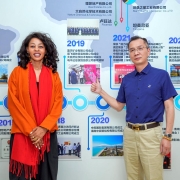
On March 24, 2026, Amb. Judyth Nsababera, Consul General of the Republic of Uganda in Guangzhou, led a delegation on a visit to CHINASTAR for a corporate tour and exchange. The visit provided an opportunity to deepen mutual understanding, review CHINASTAR’s development in East Africa, and explore the potential for continued cooperation between Chinese enterprises and Uganda.

During the visit, the delegation was introduced to CHINASTAR’s development history and its long-term commitment to the African market. At the company exhibition area, representatives presented key milestones in the Group’s international development, regional operations and project experience across East Africa.

Over the years, CHINASTAR has continued to strengthen its presence in the region, developing capabilities across engineering, manufacturing and construction while building practical experience in local project delivery. Its business activities have expanded from steel structures into a broader range of integrated construction services, supporting industrial, commercial and infrastructure development in African markets.

The delegation also gained an overview of the company’s regional business development and its ongoing efforts to combine engineering expertise, manufacturing capability and localized execution. Particular attention was given to CHINASTAR’s experience in East Africa and its continued commitment to building long-term relationships with local stakeholders.

Strengthening Connections with Uganda

Uganda is an important market within East Africa and continues to present opportunities across infrastructure, industrial development, manufacturing and construction.

The visit offered both sides an opportunity to exchange perspectives on regional development and the role that international engineering and construction companies can play in supporting local economic growth.

For CHINASTAR, Uganda has long been an important part of its East African development. The company has accumulated project experience in the country across several types of construction, including public buildings, industrial facilities and infrastructure-related projects.

Through continued localization and cooperation with local partners, CHINASTAR aims to strengthen its ability to respond to project requirements while contributing practical engineering and construction expertise to the region.

From Project Delivery to Long-Term Cooperation

As East Africa continues to urbanize and invest in infrastructure and industrial capacity, demand is growing for construction solutions that combine efficiency, quality, cost control and reliable delivery.

CHINASTAR’s development strategy is centered on an integrated approach that connects R&D, design, manufacturing, construction and service. This model enables the company to coordinate different stages of project delivery through a more unified platform while supporting quality control and operational efficiency.

The visit by the Ugandan Consulate General delegation also reflected the importance of continued engagement between enterprises and institutions in strengthening China–Uganda business connections.

Rather than focusing only on individual projects, CHINASTAR sees long-term cooperation as an opportunity to develop stronger local capabilities, deepen regional understanding and create sustainable value together with clients, partners and communities.

Building on a Shared Vision for East Africa

The visit concluded in a positive atmosphere, reinforcing the importance of communication and continued engagement between CHINASTAR and stakeholders connected to Uganda.

Looking ahead, CHINASTAR will continue to build on its experience in East Africa, strengthen localized operations and explore opportunities for cooperation across engineering, industrialized construction and related sectors.

With a long-term commitment to the region, the company remains focused on combining international engineering standards with local execution capabilities to support the next generation of development across Uganda and East Africa.

CHINASTAR looks forward to maintaining close communication with partners and institutions in Uganda and contributing its experience and capabilities to mutually beneficial cooperation and sustainable regional growth.